CLAIM YOUR 22% OFF →

Portable CarPlay Monitors: Technology, Market Trends & Challenges
Portable CarPlay Monitors: Technology, Market Evolution and Industry Challenges
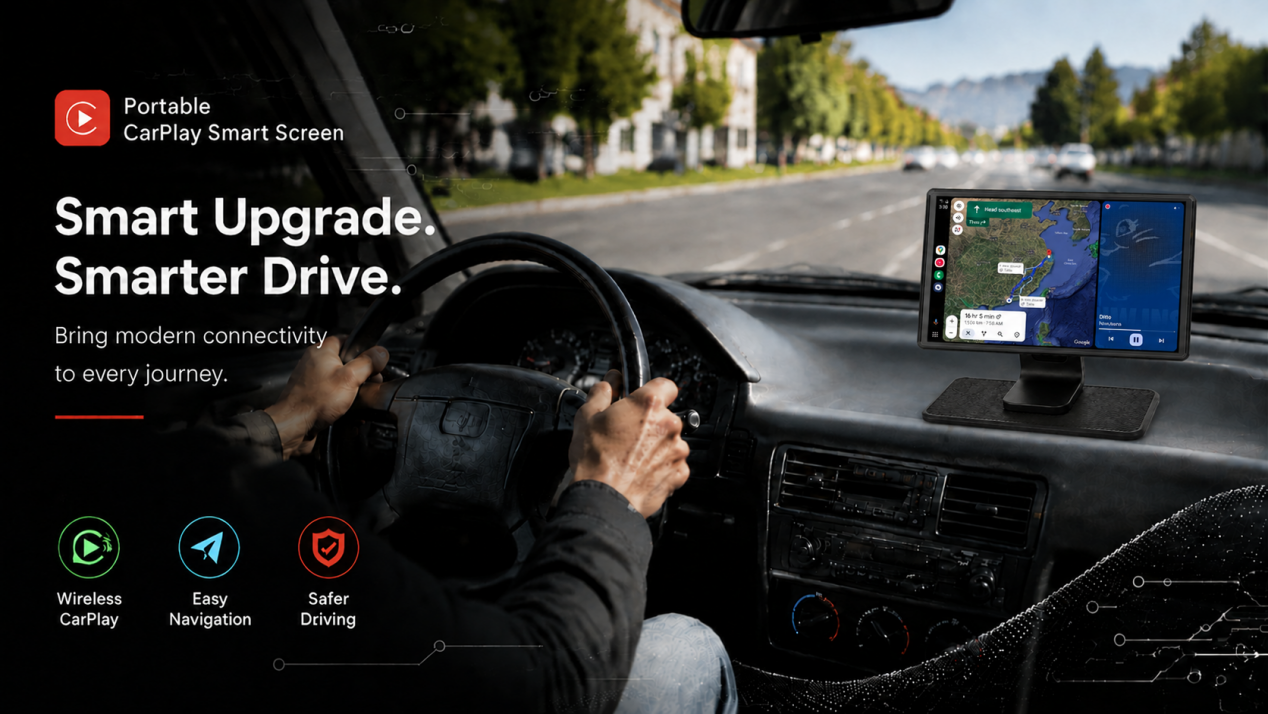
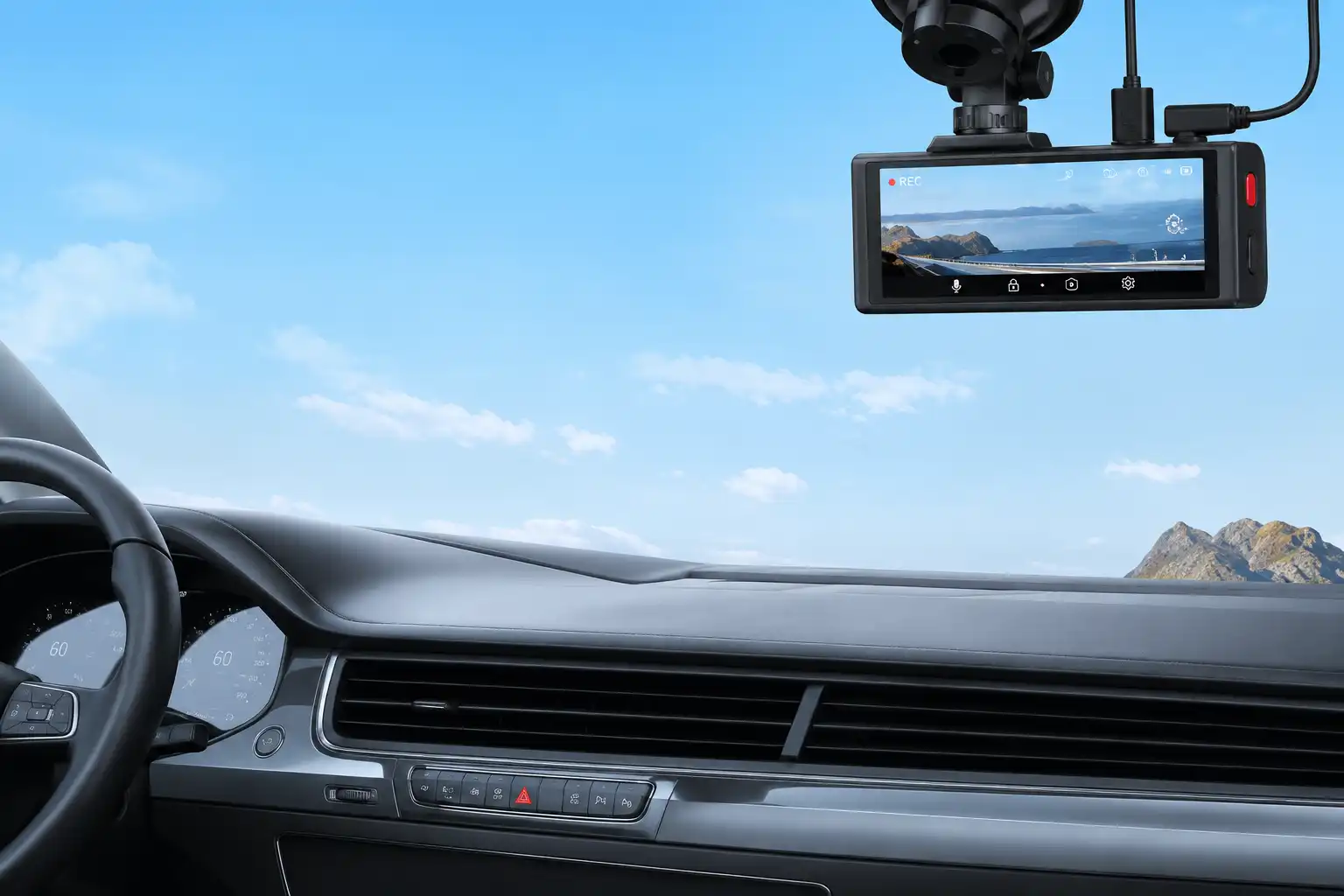
In broad terms, the portable CarPlay monitor is the next generation of the traditional Portable Navigation Device (PND). Rather than relying on the older Windows CE-based GPS navigation hardware with pre-loaded maps, it uses a Linux-based display unit designed for Apple CarPlay and Android Auto screen projection. As it relies on a smartphone for much of its functionality, it is also commonly referred to as an automotive smart monitor.
1. What Is a Portable CarPlay Monitor?
The concept of an in-car smart monitor first emerged around 2018, when DDpai launched an 8.9-inch dual-camera dash cam designed for Huawei’s HiCar ecosystem. The product was among the early attempts to bring smartphone-to-car connectivity into a portable aftermarket device.
Today, portable CarPlay monitors have become one of the leading product categories in the portable aftermarket automotive electronics market. Some industry professionals still refer to them as PNDs.
Almost all portable monitors that support Apple CarPlay also support Android Auto, so we will not repeat this compatibility point throughout the article.
These products are primarily sold in overseas markets. Common English product names include wireless CarPlay monitor, smart monitor, connected monitor system and CarPlay monitor system. For consistency, this article uses the term portable CarPlay monitor throughout.
2. Why Is There Still a Market for Portable CarPlay Monitors?
Apple CarPlay and Android Auto were first introduced in 2014, with a limited number of compatible production vehicles appearing in 2015.
Since then, the number of vehicles supporting CPAA — short for CarPlay and Android Auto — has steadily increased. Both systems are now standard factory-fitted features in most new vehicles.
However, this transition has taken place gradually. Almost all vehicles manufactured before 2015, along with a substantial proportion of vehicles built before 2020, lack native CPAA support.
Cost considerations and automakers’ long-term strategies for developing proprietary in-car ecosystems also mean that not every vehicle will necessarily include built-in CarPlay and Android Auto functionality.
This creates ongoing opportunities for aftermarket CarPlay-enabled devices.
Related product categories include:
– Aftermarket head units that replace the factory stereo.
– Wired-to-wireless CarPlay adapters for vehicles that already support wired CarPlay.
– Replacement rear-view mirror displays.
– Smart monitors designed for motorcycles.
– Portable CarPlay monitors that can be installed without replacing the vehicle’s original head unit.
This article focuses specifically on the portable CarPlay monitor category.
3. The Evolution of Portable CarPlay Monitor Technology
3.1 The First Generation: Wired Connectivity
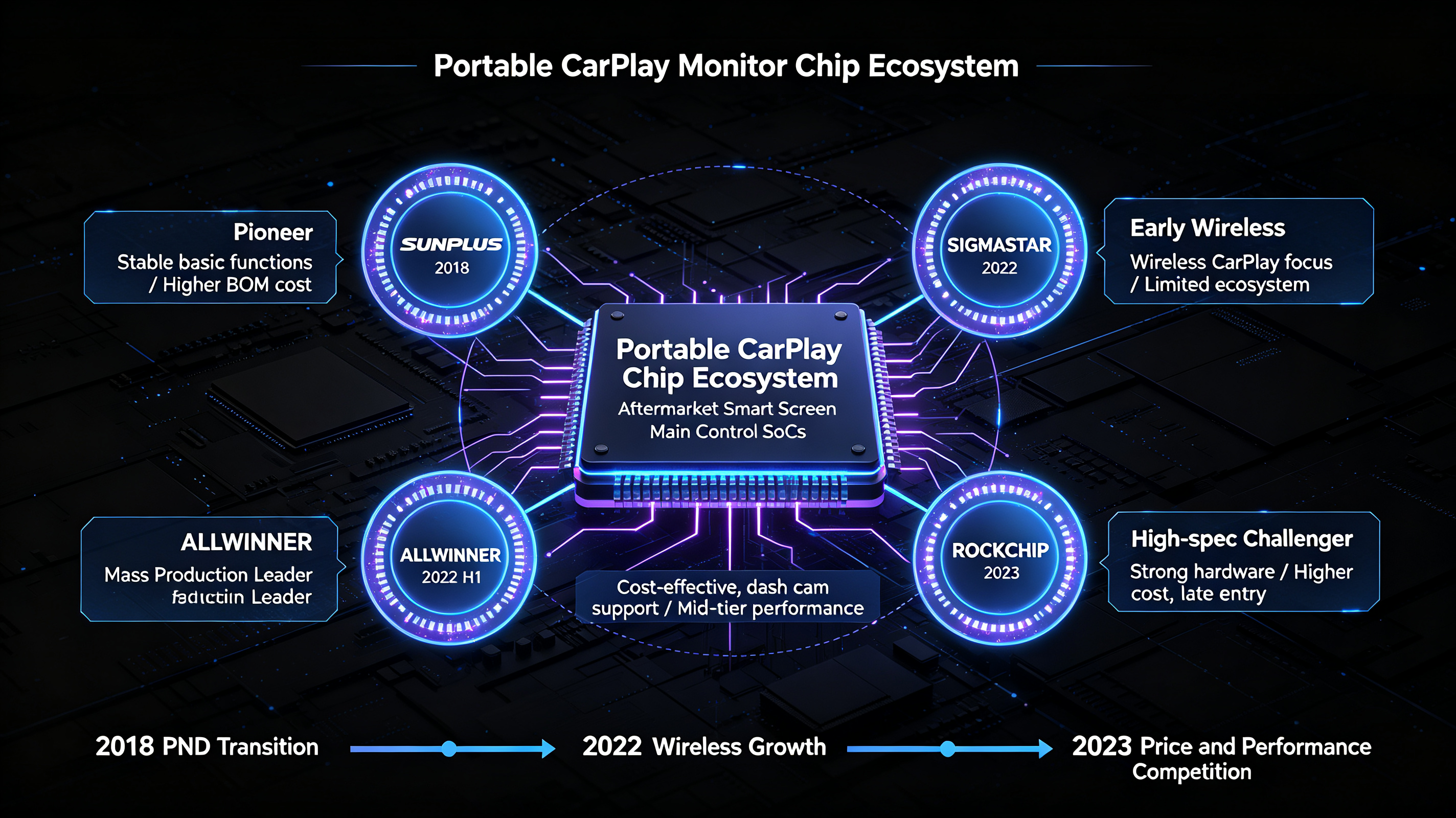
According to industry records, the first generation of portable CarPlay monitors appeared around 2018. Most were based on SUNPLUS chip solutions.
These early products had several limitations:
– They required a physical cable connection to the smartphone.
– Android Auto was generally not supported.
– Retail prices on Amazon were typically around US$300–400.
Although these products introduced smartphone connectivity to the portable monitor category, their functionality and pricing limited their broader appeal.
3.2 The Transition to Wireless CarPlay
Commercially viable wireless CarPlay monitors did not become widely available until the first half of 2022.
Early products were based on the SIGMASTAR platform, followed by solutions using ALLWINNER hardware. However, the initial generations were not sufficiently mature, with users experiencing frequent connection dropouts and unexpected reboots.
By the second half of 2022, ALLWINNER-based solutions had become stable enough for mass production. Support for front and rear dash cam recording also began to appear, making these products more versatile.
Demand subsequently increased, and ALLWINNER quickly established itself as the dominant chip platform in this market segment.
3.3 Competition Among Chip Platforms
SUNPLUS
As an early pioneer, SUNPLUS maintained a respectable share of the market. However, its relatively high bill of materials (BOM) cost and lack of integrated dash cam functionality gradually weakened its competitive position.
ROCKCHIP
ROCKCHIP, a long-standing competitor to ALLWINNER, has seen several solution providers introduce products with stronger hardware specifications. However, higher costs, an imperfect user experience and a later market entry have limited its ability to challenge the dominant platform.
SIGMASTAR
SIGMASTAR entered the market early but largely disappeared from this product segment, partly due to chip supplier policies and the circumstances of its independent design house (IDH) partners.
In late 2023, another solution provider re-entered the market with a differentiated offering aimed at niche applications.
Meanwhile, chip developers such as Goke, which is associated with Ezviz, and Eeasytech — both of which have gained traction in dash cam and security camera applications — have also been preparing competing hardware solutions.
These developments suggest that competition in the portable CarPlay monitor market is likely to continue evolving as suppliers target different price points and product applications.
4. Operating Systems: Linux vs Android vs RTOS
The operating system is another important factor affecting product cost, functionality, performance and long-term maintainability.
Three main platforms are used in portable CarPlay monitors: Linux, Android and RTOS.
4.1 Linux: The Mainstream Platform
Linux 4.9 is currently the most widely deployed operating system in portable CarPlay monitors.
However, there is an important technical consideration: Linux kernel 4.9 reached its end of life (EOL) in 2023 and no longer receives upstream security fixes or maintenance updates.
At the time of writing, no solution provider has publicly announced a portable CarPlay monitor running on a newer Linux kernel.
This raises questions around long-term software maintenance and security, particularly for products expected to remain in the market for several years.
4.2 Android: Greater Flexibility and Expandability
To meet demand for local media playback and additional applications, a small number of suppliers offer Android-based CarPlay monitors running versions ranging from Android 10 to Android 14.
These products use quad-core or octa-core SoCs from Spreadtrum. Some ALLWINNER partners are also preparing Android-based products to compete in this segment.
Android-based monitors generally have higher hardware costs, but they offer a richer software ecosystem and greater expandability.
When equipped with a GPS module, they can also support offline map navigation. This is particularly useful for specialised applications such as off-roading, overlanding and commercial freight transport, where standalone navigation can be important.
The main drawback is dash cam image quality. The image signal processor (ISP) hardware used in these Android platforms can produce noticeably poorer video quality than Linux-based alternatives.
For buyers evaluating these products, the trade-off is relatively straightforward: Android offers greater flexibility, while Linux-based solutions can provide a more suitable balance of cost and dash cam performance.
4.3 RTOS: A Lightweight, Cost-Effective Alternative
Real-time operating systems (RTOS) represent another option, although adoption remains more limited. Most products in this category are based on the ALLWINNER F133 platform, commonly described in the industry as a lightweight system.
Unlike many competing platforms built around single- or dual-core ARM Cortex-A7 or Cortex-A53 processors running at approximately 1.2 GHz, the F133 uses an RISC-based CPU clocked at just 533 MHz.
Its streamlined hardware and software architecture delivers several advantages:
– Lower hardware costs.
– Good operating stability.
– Very fast boot-up times.
– Strong cost-performance for entry-level products.
These advantages have helped the platform secure a meaningful share of the market.
Its main limitation is the lack of native dash cam recording capability. Some suppliers address this by adding external auxiliary modules.
The chip manufacturer has recently increased the onboard RAM capacity, and new revisions with support for dual-channel dash cam recording are forthcoming.
However, video encoding remains a consideration. The use of MPEG rather than the more widely adopted H.264 or H.265 codecs results in substantially larger video files. Real-world image quality also remains to be validated.
If the new chip variant performs as expected, it could trigger another round of price competition across the market.
5. Product Design and Build Quality: An Industry-Wide Challenge
Portable CarPlay monitors make modern smartphone connectivity more accessible to owners of older vehicles, without the need for a major modification to the original dashboard.
Despite these advantages, many products currently available on the market still have noticeable shortcomings in industrial design, build quality and day-to-day usability. Product homogenisation is also widespread.
5.1 Outdated Exterior Design
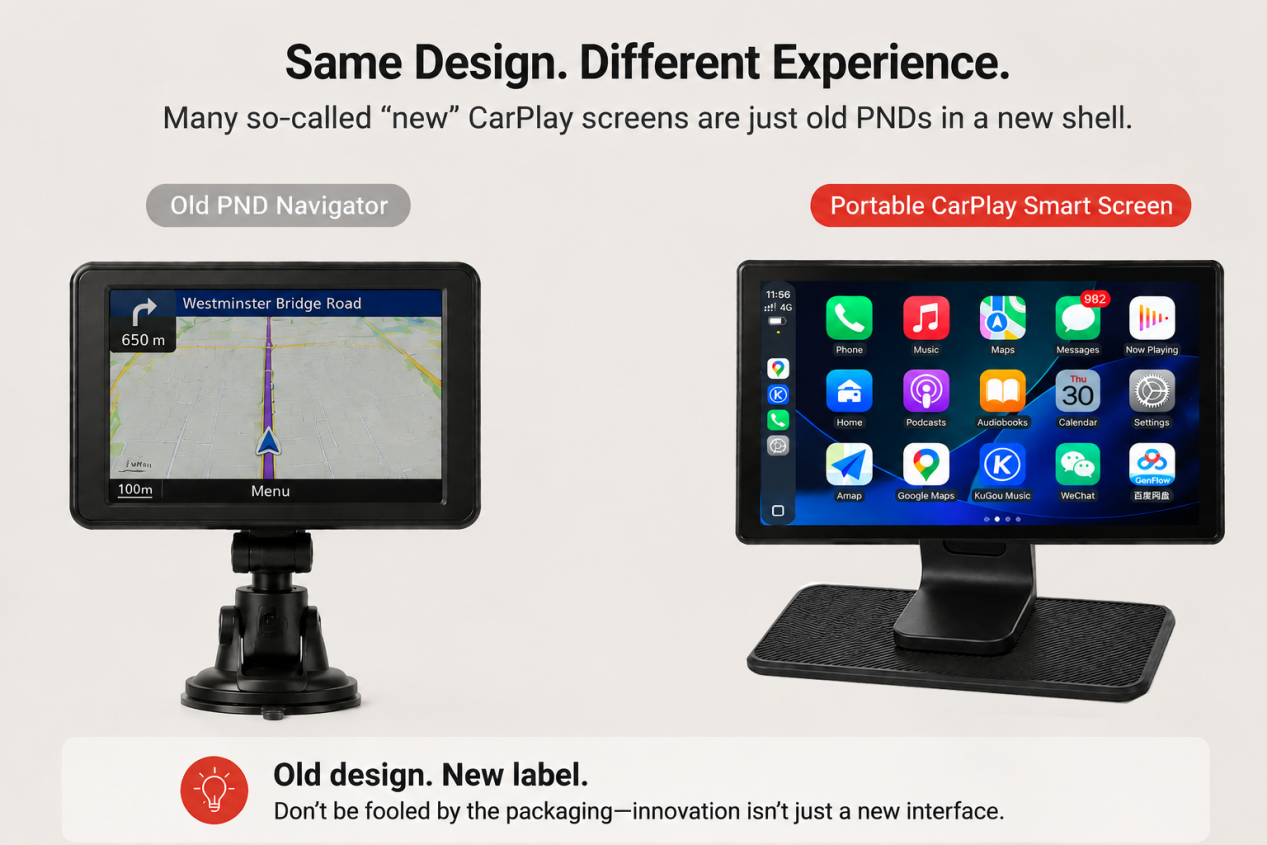
Many portable CarPlay monitors still follow the form factor of PND hardware designed more than a decade ago.
One of the most visible changes has been the transition from Mini-USB to USB-C. Beyond that, mounting systems, power supply arrangements and rear camera wiring layouts have changed very little over the years.
As a result, many products look dated and lack the refined finish that consumers increasingly expect from modern automotive accessories.
5.2 Why Has Product Innovation Been So Limited?
To understand the problem, it is necessary to look at how the portable automotive electronics supply chain is structured.
Although portable CarPlay monitors evolved from the traditional PND ecosystem, many of the independent design houses (IDHs) that developed earlier PND products have since moved into other areas.
Some have shifted their focus to security cameras, others have moved into OEM automotive-grade development, while many have simply ceased operations.
At the same time, the broader aftermarket automotive electronics market has contracted, leaving portable CarPlay monitors as a relatively niche category.
Larger IDHs with stronger engineering capabilities often overlook this segment. Many of today’s solution providers are smaller development companies with backgrounds in dash cams.
Facing intense competition and relatively low barriers to entry, these companies often prioritise getting products to market quickly and capturing short-term commercial opportunities. Existing reference designs are frequently used as the starting point.
Smaller engineering teams also have limited resources for original product development.
Consequently, manufacturers tend to focus on basic functionality and operational stability, while investing less in areas such as:
– Industrial design and product appearance.
– Materials, assembly quality and overall finish.
– Human-machine interaction (HMI).
– Long-term reliability testing and validation.
– Regulatory and compliance certification.
This helps explain why products with similar specifications can look and feel remarkably alike, even when sold under different brands.
6. Fragmented Supply Chains Make Meaningful Innovation Difficult
Another major challenge is the fragmented nature of the component supply chain.
Solution providers typically supply the main circuit board, while other key components are sourced from separate upstream suppliers. These can include:
– Product housings.
– Display panels and touch panels.
– Speakers.
– Power supply modules.
– Mounting brackets.
– Front and rear cameras.
Developing an original product design can therefore require significant R&D investment across multiple components, not just the main circuit board.
By reusing established PND mechanical designs, brands can take advantage of mature supply chains, reduce development costs and bring products to market more quickly.
From a short-term commercial perspective, this approach makes sense. However, it also makes meaningful product differentiation much harder to achieve.
Real innovation requires close collaboration among multiple suppliers across the value chain. When component manufacturers operate independently, even relatively small improvements can become difficult to implement without coordinated engineering work.
The result is an industry in which cost efficiency and speed to market often take precedence over substantial product innovation.
7. The Limitations of OEM Assembly and Customisation
Final-assembly OEMs often operate primarily as assemblers and packagers. As a result, overall product quality and perceived grade are heavily influenced by the capabilities of upstream component suppliers.
Many products marketed as high-end customisations involve relatively superficial changes, such as revised exterior styling or updated graphical user interface (GUI) designs, rather than fundamental improvements to the underlying hardware or user experience.
Within this relatively small, low-margin aftermarket segment, even leading solution providers face constraints in engineering capacity, capital investment and industrial design expertise.
Widespread product similarity fuels aggressive price competition and puts further pressure on profit margins.
Faced with the cost and risk of original R&D, many market participants choose to continue using proven legacy designs rather than invest in more substantial product development.
This creates a difficult cycle: limited differentiation encourages price competition, while shrinking margins leave manufacturers with fewer resources to invest in innovation.
8. What Does the Future Hold for Portable CarPlay Monitors?
Portable CarPlay monitors offer a practical way to bring modern connectivity to older vehicles without replacing the factory head unit. Their appeal extends across a range of applications, from everyday commuting to caravanning, overlanding and commercial transport.
However, the market still faces several challenges, including ageing hardware designs, fragmented supply chains, uneven build quality and limited differentiation between competing products.
Future opportunities are likely to depend not only on hardware specifications and selling prices, but also on improvements in industrial design, user experience, reliability, software support and application-specific functionality.
For brands, OEMs and distributors, the key question is how to move beyond basic functionality and deliver products that offer a clear, practical advantage to the end user.
In future articles, we will explore specific directions for product improvement, the reasoning behind key design decisions, broader industry trends, and the outlook for both B2B and end-consumer markets.